How to Trade Meme Coins With Just $10 and Still Keep Fees From Eating the Account
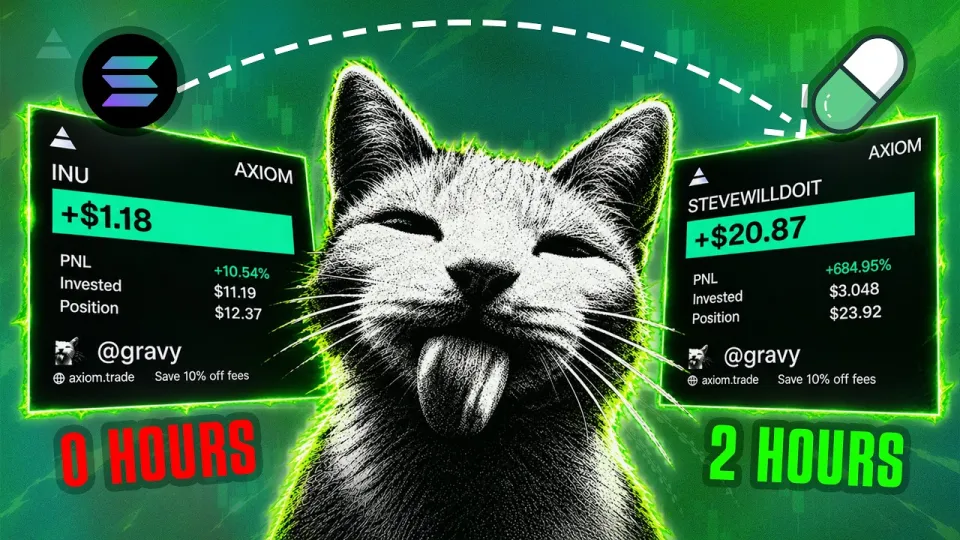
Video: I Tried Trading Memecoins with Just $10
You can order the same kind of articles for your own video to boost it on YouTube and Google. Just message the Telegram bot @sat_sit_bot. Articles with your video embedded are written and posted by the bot itself — on popular topical sites (no ads). Your first 50 articles are free.
· based on the channel gravy
Key takeaways
- Five real trades, each buy kept under 0.05 SOL — roughly the size a $10–$15 account can support on Solana.
- Coins covered: STEVEWILLDOIT, NPC, MET (Meteora), PUMPY the Trader and UNTXD, each chosen for a specific narrative.
- The X Money meta (e/acc and Cream) is the example of how a narrative spreads before price follows.
- Small size does not remove fees — it makes fee discipline the deciding factor between a green and red week.
- The experiment ends with the question of whether to live-trade a doxxed wallet starting from 0.1 SOL or 1 SOL.
You can trade meme coins with $10, but only if you treat the balance as a fee budget first and a position second. On Solana, five buys kept under 0.05 SOL each are enough to test a strategy, provided you accept that a single badly timed exit can wipe out several winners. The experiment behind this breakdown — five real trades on Axiom, where the referral link gives 2x cashback and 15% lower fees — is a useful map of what a micro portfolio can and cannot do.
What $10 actually buys you in meme coin trading
A $10 account is not a smaller version of a $1,000 account; it is a different instrument with different constraints. At Solana prices in the $150–$250 range, $10 is roughly 0.04–0.07 SOL, which means every position is a fraction of a SOL and every fee is a visible percentage of the trade.
Three costs stack on each round trip:
- Network fees — small in absolute terms (fractions of a cent per transaction) but not zero, and they multiply when you sign several transactions per trade.
- Priority fees — the tip that gets your transaction included during a launch; on a hot mint this can exceed the base fee many times over.
- Platform and liquidity costs — router or aggregator fees plus slippage, which on thin memecoin pools is the largest hidden expense.
On a $10 balance, a 1% platform fee is ten cents, and a 5% slippage hit is fifty cents. Do that ten times and the account is down before the market has done anything. This is why the reference experiment capped every buy below 0.05 SOL: it keeps the fee drag calculable and forces selectivity instead of spray-and-pray.
The five trades and the narrative behind each
The experiment is built on the idea that meme coins are priced by stories, not cash flows, so each entry needs a reason that can be stated in one sentence. The five positions illustrate different types of narrative.
- STEVEWILLDOIT — a character-driven coin where the appeal is the persona and the community around it, the kind of ticker that lives or dies on timeline attention.
- NPC — a meme built on internet archetypes, cheap to understand and easy to spread, which is exactly what makes it volatile.
- MET (Meteora) — a bet tied to an ecosystem name rather than a pure joke; the narrative borrows credibility from the underlying protocol.
- PUMPY the Trader — a trader-culture meme, aimed at the audience that already lives on launchpads.
- UNTXD — the late entry, and by the creator's own account the one that was fumbled hardest.
The X Money meta — the wave around e/acc and Cream — is the clearest illustration of how these cycles work. A narrative gains legitimacy from a credible figure or product, traders pile into the closest ticker, and the price move happens after the story is already visible. The lesson for a small account is that you are not early because you found the coin; you are early only if you found the story before the timeline did.
Position sizing rules that keep a micro account alive
Position sizing is the only risk control a $10 trader truly owns, because you cannot diversify meaningfully and you cannot average down for long. A workable structure looks like this:
- Split the balance into at least five entries, so no single loss removes more than about 20% of the account.
- Cap each buy at 0.05 SOL or less, matching the constraint used in the experiment.
- Decide the exit before the buy: a fixed percentage target, a narrative invalidation, or a time stop.
- Never add to a losing position with the last of the balance.
- Count fees as part of the loss, not as an afterthought.
With $10, a 2x on one position pays for several failed attempts, which is the entire logic of asymmetric betting. The problem is that most small accounts take profits too early on winners and hold losers too long, which inverts the asymmetry. A 20–40% loss cut is rational only if the winners are allowed to run past 100%; otherwise the math never closes.
Why finding good narratives is the real bottleneck
Narrative research is the part of meme coin trading that does not scale down with account size, and it is where most beginners stall. Scanning timelines, remembering which accounts actually move a ticker, and judging whether a story is early or already priced in takes hours — the same hours whether you are trading $10 or $10,000.
The practical fix is to narrow the funnel rather than widen it:
- Follow a small, curated list of accounts that have historically been early, and prune it monthly.
- Track one ecosystem at a time instead of every chain at once.
- Write down the thesis in one line before buying; if you cannot, you do not have a thesis.
- Treat a coin that already ran 300% as a different trade with different risk, not the same trade entered late.
The recurring complaint from traders who lose on good narratives is timing: they buy the dip, the dip continues, they cut at a loss, and then the coin recovers without them. That pattern is usually a sizing problem disguised as a research problem — the position was too large to hold through normal volatility.
Common questions from small-portfolio traders
Small accounts generate predictable doubts, and most of them have concrete answers.
"Isn't $10 too little after fees?" It is too little to generate meaningful income, but not too little to test execution, timing and discipline. The fee drag is proportionally larger, which makes it a stricter training environment than a larger account.
"What was the total PnL?" The experiment walks through each trade individually rather than presenting a single portfolio number, and the creator invites viewers to request a live session with a doxxed wallet to settle the question properly.
"How do you build a timeline that actually surfaces coins?" Curate aggressively. A feed full of noise is a research failure, not a market condition.
"Should I start with 0.1 SOL or 1 SOL?" That is the open question at the end of the video. 0.1 SOL forces precision; 1 SOL allows more experiments but also more damage per mistake.
Useful links
- Trade on Axiom — registration through the referral gives 2x cashback and 15% lower fees.
- The Trenches Discord — the trading community around the channel.
- Discord with free Axiom imports and trade signals (NFA)
- gravy on X — trade updates and commentary.
- Leverage trading with a 20% futures fee reduction
Bottom line
Trading meme coins with $10 is possible, and the real constraint is not the balance but the discipline around fees, sizing and narrative timing. Five trades under 0.05 SOL each are enough to learn whether you can hold a winner and cut a loser without emotional interference. The experiment is worth watching as a template rather than a blueprint: the coins will not repeat, but the process will. The breakdown comes from the gravy channel, which covers Solana meme coin trading with small balances and is now weighing a live session starting from 0.1 SOL. If you want to replicate the setup, start through the Axiom referral link and keep the first ten trades deliberately small.
Source: I Tried Trading Memecoins with Just $10 · Markdown version
Questions & answers
Can you really trade meme coins with only $10?
Yes, technically. On Solana, $10 is roughly 0.04–0.07 SOL, which is enough for several sub-0.05 SOL entries. The limit is not access but economics: fees and slippage take a larger share of each trade, so the account works as a practice environment rather than a source of income.
How much do fees eat on a small meme coin trade?
Network fees themselves are tiny, but priority fees during a launch plus slippage on thin liquidity can add up to several percent per round trip. On a $10 balance a 5% slippage hit is fifty cents, so ten trades can cost a meaningful part of the account before the market moves at all.
Why do traders lose money even when they pick coins with good narratives?
Usually because of timing and sizing rather than the thesis. A position too large to hold through normal volatility gets cut at a 20–40% loss right before the recovery, which turns a correct read into a realised loss and inverts the risk-reward the trade was supposed to have.
Should a beginner start with 0.1 SOL or 1 SOL?
0.1 SOL forces precision and keeps mistakes cheap, which suits learning execution and fee awareness. 1 SOL allows more experiments and more tolerance for volatility but multiplies the cost of every error, so it makes sense only after the process is already consistent.